
Client:
HS2 Ltd
Location:
London, UK
Build time:
2017 - present
HS2 London Tunnels and Approaches
STRABAG is planning and constructing the London Tunnels and Approaches section of the HS2 megaproject as part of the SCS consortium, a joint venture between Skanska, Costain, and STRABAG (SCS JV).
In 2020, construction began on Europe’s largest infrastructure project, HS2 - a high-speed railway, and the first to be built in the UK in over a century.
Shortly after winning the contract in 2017, SCS JV commissioned Design House (a joint venture between STRABAG, Arup, and TYPSA) to complete the design for the project. The success of the joint venture lies in the full integration of all three construction partners with the client, HS2, who is also embedded in the project team.
From the centre of London to the M25 (London’s orbital motorway), 95% of the high-speed line will run through tunnels. It is this that the SCS JV has been tasked with - constructing 13 miles of twin-bore tunnels across 22 sites.
The project spans an impressive 2,535,000 square metres of land, with the 22 sites divided into three key areas:
- West Delivery Unit
- Tunnels and Shafts Delivery Unit
- Euston Delivery Unit
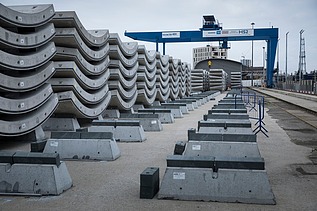
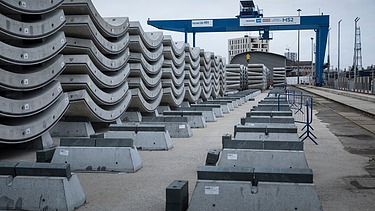
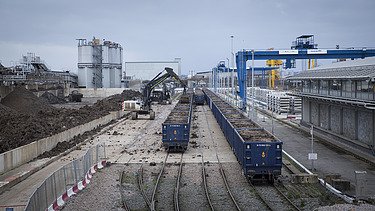
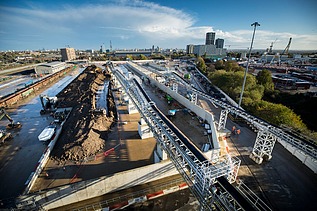
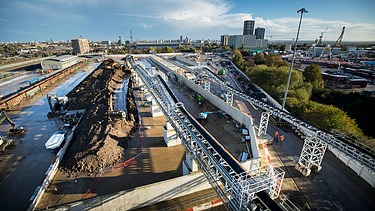
Furthermore, based in Willesden Junction, the Logistics Hub manages the logistics for all 22 sites spanning three key areas, including the movement of materials into SCS sites, the rail solution to receive deliveries of pre-cast tunnel segments and process earth from 42 kilometres of excavated tunnel, and the management of security and sub-contractors.
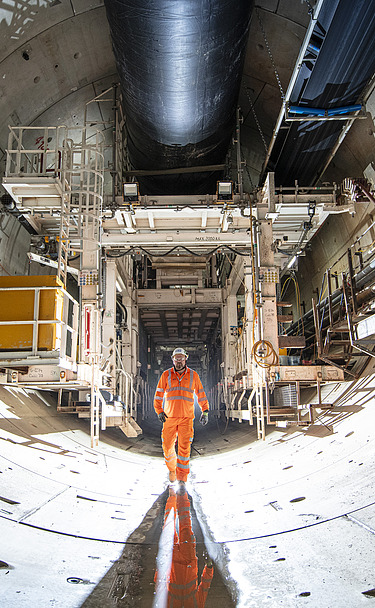
Six tunnel boring machines (TBMs) are building the tunnels between West Ruislip and Old Oak Common station in West London and then on to Euston station in central London. A seventh TBM was used to build a logistics tunnel to support the construction of the Euston Tunnel.
These state-of-the-art TBMs were specially designed with a robotic arm that picks up tunnel segments and inserts them into place, a process that previously involved people. This innovation improves both safety and efficiency within the project.
An innovative, self-travelling, electric platform also allows the first-stage concrete at the base of the tunnel to be installed at the same time as the tunnel drive is taking place. This enables initial track works to be carried out simultaneously with tunnel construction, saving time and improving efficiency.

HS2 trains will travel through the 4.5 mile-long Euston Tunnel and arrive at the Euston Approaches tunnels, which will pass underneath the existing railway and where one tunnel will split in two, making three tunnels in total.
A crossover cavern is being constructed due to the significant constraints of the site, where trains can switch tracks underground.
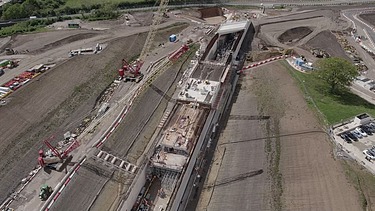
SCS JV is also extending two bridges for the new tracks to pass under. The three tunnels are being built under a 12-metre-high, 150-year-old heritage Victorian retaining wall (The Park Village East Wall). The confinement of the Euston Approaches site and tunnels poses an immense challenge, as it sits between the Park Village East Wall and is three metres away from the existing live railway line.
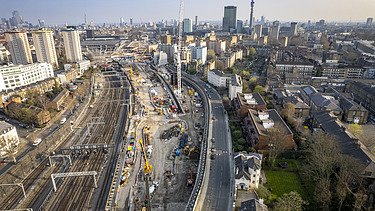
As well as the tunnels, additional structures have been constructed across the project. These include six vent shafts that connect the tunnels to the open air, helping to regulate air quality and temperature, and providing evacuation and access points.
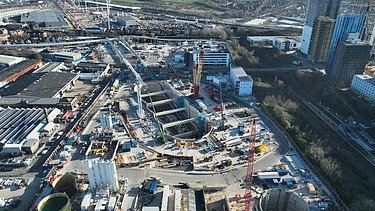
The Victoria Road Crossover Box (VRCB) structure was designed to allow the HS2 trains to switch between tracks when approaching and departing from Old Oak Common station. The innovative approach of building the box in a caterpillar shape instead of a rectangle has reduced the amount of concrete needed by 40% and allows for the transfer of forces around to the props.

-
-
-
-
-